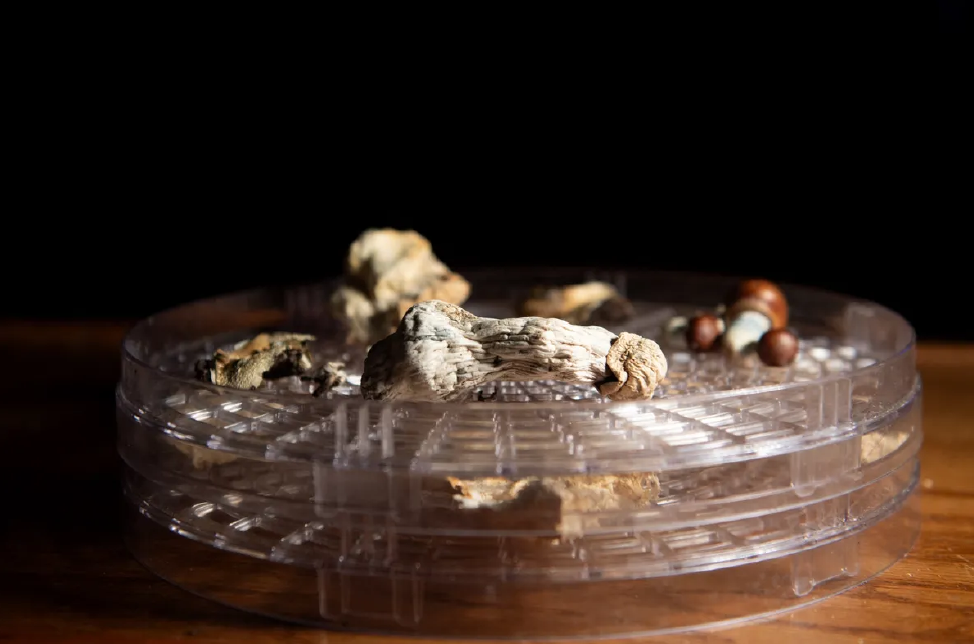
Psilocybin mushrooms on a dehydrator tray. Photographer: Jason Connolly/AFP/Getty Images
By Charles Gorrivan
September 3, 2025 at 3:00 AM PDT
Corrected September 3, 2025 at 9:04 AM PDT
Hi, it’s Charles in New York. When Brave New World author Aldous Huxley was on his deathbed in 1963, his wife injected him with two doses of LSD, the powerful psychedelic, as he slipped away. Was Huxley on to something? More on that in a moment, but first …
Today’s must-reads
RFK Jr. set new priorities for the CDC after firing its director.
A big Danish pension fund bets that Novo Nordisk will turn things around.
Creatine sales surge as more women and seniors embrace supplements.
Last trip
Sunil Aggarwal began to imagine the potential that psilocybin, the hallucinogen in “magic mushrooms,” could have for patients confronting terminal illness when he was completing a physical medicine and rehabilitation rotation during his residency at Bellevue Hospital in New York over a decade ago.
He’d recently been introduced to researchers at New York University who were running trials of the drug. In seminars connected to the study, he listened as investigators read out narratives from patients who, reconciling themselves with the prospect of death, emerged from guided psychedelic sessions with a newfound gratitude for life.
Back at Bellevue, Aggarwal wanted to introduce that treatment to a patient whose stage 4 prostate cancer had metastasized to his bones.
“He was racked with pain. He was under a lot of spiritual distress. I just remember a sense of dread and hopelessness,” Aggarwal recalled. “I was like, this would be a perfect candidate.”
The patient was willing. But strict eligibility rules for the clinical trial and the drug’s illegal status kept the therapy out of reach. The problem was that the federal government classifies psilocybin as a Schedule I substance, meaning it has no accepted medical use and a high potential for abuse. For psilocybin to become more medically accessible, the drug would have to be moved to Schedule II.
Aggarwal, now a Seattle-based palliative care physician, and the Advanced Integrative Medical Science Institute clinic he co-founded have been fighting in court to make that change happen.
Aggarwal first tried about five years ago, but courts sided with the Drug Enforcement Administration to block him. In 2022 he petitioned to move psilocybin out of Schedule I, which prompted an appeals court to tell the agency to revisit its denial.
In August, the DEA sent Aggarwal’s petition to downgrade psilocybin to Health and Human Services, according to emails reviewed by Bloomberg News.
The HHS and FDA didn’t comment on the state of the petition, referring inquiries to the DEA, which also declined to comment.
While US regulators rejected the use of psychedelic drug MDMA to treat post-traumatic stress disorder last year, HHS Secretary Robert F. Kennedy Jr. has supported using psychedelic therapies for depression and trauma.
The use of psychedelics to treat major depressive disorder is gaining some support from researchers and US states, and a handful of countries have begun to allow doctors to prescribe them. And AbbVie recently agreed to pay up to $1.2 billion for Gilgamesh’s experimental depression treatment using psychedelic compounds.
Psilocybin often evokes images of hippies chasing mystical visions, but science has shown that it can produce euphoria and even profound spiritual breakthroughs. Clinical trials suggest these experiences can help patients cope with treatment-resistant depression and post- traumatic-stress disorder.
The drugs have also been found to help patients cope during end-of-life palliative care. That’s been the focus of Aggarwal’s work. He believes psilocybin can help dying patients better process depression, anxiety, pain and hopelessness.
“You’ve saved the quality of life,” said Aggarwal. “That is the best thing that you can do.”
The treatment has the support of many patients. Catherine LeBarron was diagnosed with breast cancer in 2023 and used psilocybin to help trust her caretakers during chemotherapy.
After consulting with a naturopathic doctor, she travelled from Washington to a psychedelic healing center in Oregon, where laws allow supervised psilocybin use at licensed centers.
There, she drank psilocybin-infused tea, wrapped herself in heated blankets and donned an eye mask before working with a facilitator to overcome her fears.
“I went into a moment of serenity and calmness, and just leaned into the fear and the pain that was coming up,” LeBarron said.
LeBarron’s trip, which cost her about $2,500, began to show results after her first chemotherapy treatment, when she suffered an allergic reaction and went into anaphylactic shock. She turned to memories of her trip to collect the courage to trust her doctor.
“If I hadn’t had the journey beforehand, I wouldn’t have been able to talk to her and tell her what was going on with me,” said LeBarron, who has since largely recovered from her cancer. “That was really where the therapeutic value was.”
Stories like that make Aggarwal optimistic about his work.
“It’s another way to think about preserving people’s dignity, autonomy, in the world, with the time they have left,” he said. — Charles Gorrivan
What we’re reading
A change in screening recommendations may have led to a rise in advanced prostate cancer diagnoses, the New York Times reports.
Could the US government track data from wearable health monitors? New York Magazine talks to a cybersecurity expert.
The craze for fiber-enriched foods have prompted health experts to warn that overconsumption could lead to problems, the Wall Street Journal reports.
Contact Prognosis
Health questions? Have a tip that we should investigate? Contact us at AskPrognosis@bloomberg.net.
(Updated to give the full name of Aggarwal’s institute arguing that psilocybin should be reclassified as a Schedule II drug by the US government.)
Loading Viewer...